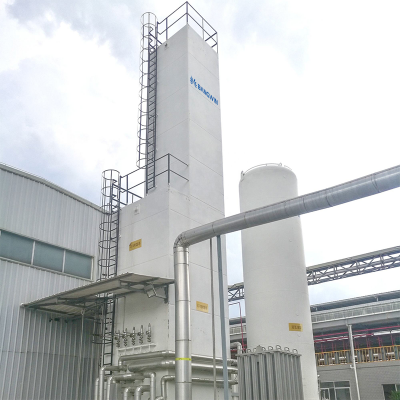
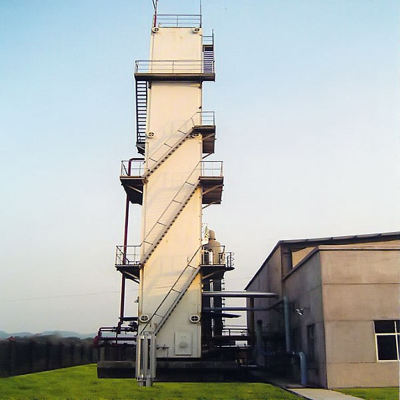
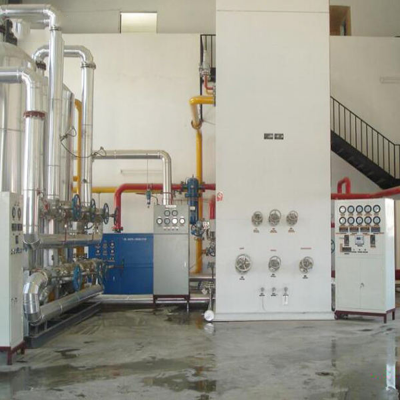
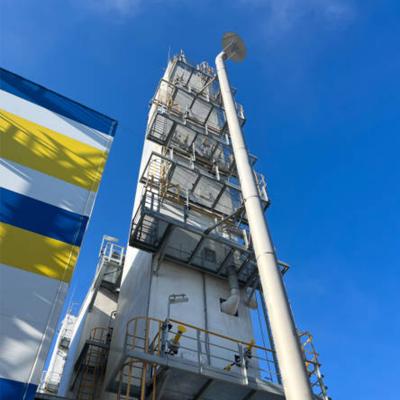
-
WhatsApp / Mob : +86 156 5177 2521
-
e-mail : mrwin@cnbangwin.com
WhatsApp / Mob : +86 156 5177 2521
e-mail : mrwin@cnbangwin.com

Industrial Liquid Oxygen Plant for Sale: Specs and Scope
Nov 19 , 2026BANGWIN sells custom-built cryogenic air separation units that produce liquid oxygen, with liquid nitrogen and liquid argon as options. Every industrial liquid oxygen plant for sale from this manufacturer is engineered to a stated duty rather than picked from a stock list, and it ships FOB China.
The equipment separates air by cryogenic distillation. Air is compressed, cleaned of moisture, carbon dioxide and hydrocarbons, cooled to cryogenic temperature inside a cold box, and distilled into oxygen and nitrogen. Oxygen leaves the low-pressure column as a liquid at about -183 °C at atmospheric pressure. A cryogenic pump raises it to your required pressure, or it goes to storage for later vaporising and dispatch.
Two product families matter when you compare an industrial liquid oxygen plant for sale:
Small and medium-sized air separation equipment
● built as compact or skid-mounted units, sized for on-site liquid production and cylinder filling.
Large air separation equipment
● built as single trains for continuous, high-volume oxygen, nitrogen and argon production.
[Internal link suggestion: cryogenic liquid oxygen plant engineering and sourcing guide -> confirm target URL before publishing]
One honest caveat before you read the numbers below. An industrial liquid oxygen plant for sale in this category is engineered to order. Published figures describe reference units, not a catalogue you can order off the shelf, and the useful comparison happens on your own duty sheet.
the standard supply covers the process island: air compression, purification, cold box with distillation columns, expansion and control equipment, plus product handling items when they are listed in the offer. Site work and utilities sit with the buyer.
Typical contents of a BANGWIN offer for an industrial liquid oxygen plant for sale:
Process block:
● main air compressor, air pre-cooling, molecular sieve purification unit, cold box containing the main heat exchanger and distillation columns, turbo-expander.
Control block:
● PLC or DCS control system, instrumentation, oxygen analyser, valve station and cabling inside the battery limit.
Product handling:
● cryogenic liquid pump for LOX and LIN, vaporiser, and the piping interface to your pipeline, storage tank or filling station.
Services:
● engineering drawings, factory testing, installation guidance by engineers at site, operator instruction, and commissioning support.
Documentation:
● general arrangement drawings, P&IDs, operation and maintenance material, and test records.
Ask for the battery limit drawing with your quotation. That single drawing defines where the supplier's scope ends and yours begins, and it decides the size of your civil, electrical and piping packages.
the manufacturer publishes a parameter table for its large series, covering oxygen output from 11,000 to 20,000 Nm³/h at 99.6% O2 purity, with liquid output figures listed per model. Smaller models are published by designation, not by a full parameter sheet.
This is the model table published for an industrial liquid oxygen plant for sale in the large series, taken from the large air separation equipment product page:
Parameter
KDON(Ar)-11000/20000-300
KDON(Ar)-12000/24000-400
KDON(Ar)-13000/22000-350
KDON(Ar)-16000/20000-520
KDON(Ar)-18000/36000-600
KDON-20000/20000
Oxygen output, Nm³/h
11,000
12,000
13,000
16,000
18,000
20,000
Oxygen purity, % O2
99.6
99.6
99.6
99.6
99.6
99.6
Nitrogen output, Nm³/h
20,000
24,000
22,000
20,000
36,000
20,000
Liquid oxygen output, Nm³/h
not listed
not listed
not listed
not listed
not listed
800
Liquid nitrogen output, Nm³/h
300
400
350
520
600
not listed
Liquid argon output, Nm³/h
not listed
not listed
not listed
not listed
600
not listed
Power consumption, kWh per Nm³ O2
1.3
0.85
0.68
0.68
0.65
0.65
Three reading notes matter:
The consumption row is published with a "not more than" operator.
1. That character is mis-encoded on the source page, so confirm the exact inequality before republishing the figures.
Only one published model lists a liquid oxygen output.
2. If liquid oxygen is your product, ask for the liquefaction ratio and the LOX tonnage per day for your specific unit. Do not infer it from the model code.
Nitrogen purity is published in parts per million oxygen
3. and the published values in that row are inconsistent in format. Treat it as an open item, and fix it in the contract instead of relying on the page.
[Internal link suggestion: small and medium-sized air separation equipment -> confirm target URL before publishing]
The smaller range is published by designation only. Verified model codes currently on the site include KDON-50/50, KDon(Ar)-40Y/40Y, KDON-100Y/20Y, KDON-150Y/30Y, BW-KDON-300Y-50Y, KDON(Ar)-650/10Y, KDON(Ar)-1200Y/20Y and KDON(Ar)-1500Y/30Y. The naming encodes product and capacity, but the pages for these models do not publish a parameter table, so request the datasheet before you shortlist.
convert your requirement into oxygen Nm³/h and tonnes of liquid per day, add the pressure at your battery limit, then let the supplier size the unit. Choose a model from your own duty sheet, never from a neighbour's plant.
Work through four numbers before you compare an industrial liquid oxygen plant for sale against a delivered-supply contract:
Gas demand.
1. Average, peak and minimum oxygen consumption in Nm³/h, with the profile across a day and across a year.
Liquid demand.
2. Tonnes of LOX per day. For sizing, one tonne of LOX equals roughly 750 Nm³ of oxygen gas, using a liquid density near 1.14 kg/L and an expansion ratio near 1:860.
Pressure at the boundary.
3. Gas delivered at pipeline pressure and liquid drawn into a tank are different machines.
Purity grade.
4. Standard cryogenic oxygen sits at about 99.5% to 99.6% O2. Medical supply must additionally satisfy the pharmacopoeia and registration rules of your market.
Then apply a scale check. Larger units cost less per unit of output, but a plant running far below its rating wastes power and capital. If your demand will double in three years, ask the supplier to reserve plot space, pipe connections and electrical headroom now rather than buying a bigger unit you cannot load.
the site publishes several different delivery figures for the same category. Treat published lead times as an opening position, and fix one date in the contract.
Published figures, taken from the product pages themselves:
Published statement
Where it appears
Lead time 1 to 4 months
Product data block on model pages
Production time normally 6 months for air separation plants, depending on capacity
Product page question and answer block
Cryogenic air separation unit: at least 3 months
Product page question and answer block
Cryogenic liquid plant: at least 5 months
Product page question and answer block
Delivery date 3 to 5 months
Product page question and answer block
PSA series and gas compressors: 10 to 15 days
Product page question and answer block
[Internal link suggestion: liquid oxygen plant price structure -> confirm target URL before publishing]
An industrial liquid oxygen plant for sale in this category is fabricated, pressure-tested in parts, packed and then reassembled at site, so a short published lead time usually describes standard components rather than a complete liquid plant. Two project events decide your real date: the arrival of the main air compressor and cold box, and site readiness for civil and electrical work.
Write three dates into the contract instead of one: factory acceptance date, shipment date and the date the supplier's commissioning engineer arrives. Add a milestone schedule that includes cooldown and the performance test, so a delay is visible in weeks rather than in surprises.
the manufacturer publishes a warranty of 12 months from successful operation, or 14 months from the shipment date, whichever comes first, and describes free lifetime technical support. Confirm the trigger and the spares terms in writing.
Term
Published position
What to confirm
Warranty period
12 months from successful commissioning, or 14 months from shipment
Which trigger applies to your schedule
Technical support
Lifetime technical support, free of charge
Scope, response time, language, remote or on site
Maintenance
Long service life and free maintenance claims appear on product pages
Which parts and labour, and for how long
Installation
Engineer guidance at site
Number of engineers, days, travel cost owner
Training
Operator instruction offered
Duration, location, material language
Spares
Wear and consumable parts supported
Priced list, lead time, storage recommendations
The commercial terms published for an industrial liquid oxygen plant for sale are workable, but several of them are stated as marketing claims rather than contract clauses. Service life and maintenance promises in particular need to appear in the contract text, because a claim on a web page gives you no remedy.
an industrial liquid oxygen plant for sale makes sense when demand is continuous enough to keep the unit loaded, and when delivered supply exposes you to price or availability risk.
The company publishes oxygen and nitrogen equipment for these uses:
Healthcare and medical gas:
● hospital oxygen, bulk tanks and cylinder filling, where supply interruption is not acceptable.
Metal working:
● cutting, brazing, furnace enrichment and glass melting.
Chemical and petrochemical processing:
● oxidation duties, syngas and process oxygen.
Environmental and water treatment:
● aeration and ozonation feeding.
Aquaculture and food processing:
● oxygen dosing and cryogenic freezing or inert packaging with nitrogen.
Merchant gas business:
● liquid production for tanker dispatch and cylinder filling, where plant availability drives revenue directly.
The manufacturer's own project notes on the site reference installations and customer work in China and in export markets including Chile, Peru, Venezuela, St. Vincent, Nepal, the Philippines, Bangladesh, Malaysia, Argentina, India, Indonesia, Kazakhstan, Pakistan, Iraq, Egypt and several African countries. Treat these as published activity rather than as performance references, and ask for a contactable reference at a similar capacity and climate.
send a one-page duty sheet with your demand, product mix, boundary conditions and commercial frame. A complete first enquiry shortens quotation time and prevents a specification that cannot be priced.
Include these eight items when you enquire about an industrial liquid oxygen plant for sale:
1. Oxygen required as gas in Nm³/h and as liquid in tonnes per day, with average, peak and minimum.
2. Purity required, and whether the product is medical or industrial grade.
3. Delivery pressure and temperature at the battery limit.
4. Site location with design ambient temperature range, humidity and elevation.
5. Available electrical supply: voltage, frequency, transformer capacity and starting limits.
6. Cooling water availability, or the requirement for air cooling.
7. Storage autonomy required and dispatch method: pipeline, cylinders or tanker.
8. Commercial frame: Incoterms wanted, currency, required on-site date and certification route.
Expect the supplier to return a process proposal, a plot layout and then an itemised offer. Ask for the exclusion list at the same time, because the missing lines explain most late variation orders.
before you commit to an industrial liquid oxygen plant for sale, check published claims against the contract, because this site states different service lives and different lead times on different pages.
Three specific inconsistencies exist on the site today, and each one is worth resolving before you commit:
Claim
Version A
Version B
Action
Plant service life
Large unit category page states more than 25 years
Product page states 15 to 20 years with proper maintenance
Ask which design life applies to your unit and what drives the difference
Company history
Homepage highlights 21 years
A product page claims over 40 years
Ask for the company registration date and use documents, not marketing text
Delivery time
Product data block states 1 to 4 months
Product page answers state at least 5 months for a cryogenic liquid plant, and 6 months production
Require a contractual delivery date with milestones
Then complete six verification steps:
1. Request the certificate documents themselves, not a photo gallery of certificates.
2. Ask for a video factory tour, or visit, and confirm which items are made in house and which are purchased.
3. Request a contactable reference operating at a similar capacity in a similar climate.
4. Ask for the third-party inspection plan for pressure parts and the applicable code edition.
5. Put the guarantee values, the test method and the remedy for a shortfall into the contract annex.
6. Have the offer reviewed by an engineer who has commissioned a cryogenic air separation unit before.
Nanjing Bangwin Gas Equipment Co., Ltd. manufactures industrial gas separation and liquefaction equipment in China and exports under the BANGWIN brand. Its product range covers cryogenic air separation units, PSA and VPSA oxygen plants, PSA nitrogen generators, membrane nitrogen systems, hydrogen generators, booster compressors, small liquid nitrogen generators and industrial gas storage tanks.
For a buyer comparing an industrial liquid oxygen plant for sale, three points are worth noting. The company publishes separate ranges for small and medium-sized units and for large air separation equipment, so the enquiry route is by duty rather than by fixed catalogue size. Its product pages list model designations in the KDON and KDON(Ar) pattern, which encode oxygen, nitrogen and argon outputs. And it publishes factory testing plus on-site installation guidance and commissioning support as part of the package.
Performance claims on the site, including a stated energy saving of 10% to 20% against conventional designs and a long service life, are company statements. Ask for the guarantee basis and the measurement boundary before you carry any of those figures into an investment case.
[Internal link suggestion: contact page -> confirm target URL before publishing]
Send your eight-item duty sheet and site conditions, and request an itemised offer with a battery limit drawing, an exclusion list and the published parameter table completed for your specific model.
Each unit is engineered and built to the buyer's duty sheet. Published model tables describe reference configurations, so the specification is confirmed in the proposal rather than selected from stock.
One complete plant. These units are custom-engineered systems, so suppliers quote per project rather than per unit quantity. Ask the supplier to confirm this in writing for your case.
Ask for both prices. The site quotes FOB China as the standard basis, and a CIF figure lets you compare landed cost rather than freight separately. Confirm which port and which insurance limits apply.
Installation guidance, commissioning support and operator instruction are offered, but they are usually separate priced lines rather than part of the equipment figure. Confirm engineer count, days, travel cost and the standby terms.
Yes, where the design includes the relevant columns and draws. The published large-series table lists liquid nitrogen and liquid argon outputs for specific models, and an argon circuit is a design decision rather than an accessory.
Yes. Small and medium units are commonly paired with LOX storage, a cryogenic pump and a filling manifold. Size the storage tank from daily demand and the autonomy you need, then match the pump and manifold to peak draw-off.
As-built general arrangement drawings and P&IDs, material certificates, pressure test and non-destructive testing records, factory acceptance test results, operation and maintenance manuals and the commissioning report. Specify the language in the contract.
the published model table gives you a defensible starting point, but the contract must carry the numbers that matter.
Three points decide whether the purchase works. Confirm the model's guaranteed oxygen output, purity and liquid tonnage for your duty, rather than reading them off a reference table. Fix one delivery date with milestones, because the site itself publishes several lead times for this equipment class. Put the warranty trigger, service life claim and performance
remedy into the contract annex, where they can be enforced.



 IPv6 rete supportata